Mommy Makeover Recovery in the USA

Mommy Makeover Recovery in the USA: Timeline and Healing Tips by Dr. Glenn Lyle

Mommy makeover recovery is usually a bigger commitment than recovery from a single procedure because it often combines breast surgery, tummy tuck surgery, liposuction, or other body contouring procedures in one plan. With the right preparation and guidance, patients can move through recovery with more confidence and fewer surprises.

Most women considering a mommy makeover want to know when they can return to work, care for children, exercise, and feel comfortable in their body again. The answer depends on which procedures are included, how much repair is needed, and how closely the recovery plan is followed.

Dr. Glenn Lyle, a board-certified plastic surgeon in Raleigh, NC, personalizes mommy makeover surgery around each patient’s anatomy, lifestyle, pregnancy-related changes, and goals. His approach focuses on natural-looking results, safe surgical planning, and a recovery process that supports long-term confidence.

What Does a Mommy Makeover Actually Include?

A mommy makeover usually includes a customized combination of procedures that improve the breasts, abdomen, waist, or other areas affected by pregnancy, breastfeeding, weight changes, and aging. One patient may need a tummy tuck and breast lift, while another may benefit from breast augmentation, liposuction, breast reduction, or fat transfer.

Mommy makeover surgery is not a single operation with the same steps for every patient. It’s a personalized surgical plan designed to improve loose skin, stretched abdominal muscles, stubborn fat, breast volume changes, breast sagging, or overall body proportion.

Dr. Lyle’s goal is not to create an exaggerated or overdone result. He focuses on helping patients look refreshed, balanced, and natural while improving the areas that haven’t responded to diet, exercise, or time.

How Long Should You Plan to Recover After a Mommy Makeover?

Most mommy makeover patients should plan for about two to three weeks of meaningful downtime, especially when a tummy tuck is included. Full recovery takes longer because swelling, scar healing, breast settling, and abdominal repair can continue improving for several months.

  • The first week usually requires the most help at home, especially with children, pets, meals, and transportation.
  • Desk work may be possible around two to three weeks, depending on the procedures performed and your energy level.
  • Light walking starts early, but lifting and exercise need to wait until Dr. Lyle clears you.
  • Tummy tuck recovery often determines the overall timeline because muscle repair takes time to heal.
  • Final results may continue developing for 6 to 12 months as swelling fades and scars mature.

A mommy makeover recovery timeline should be flexible because combined procedures can make healing more layered than a single surgery.

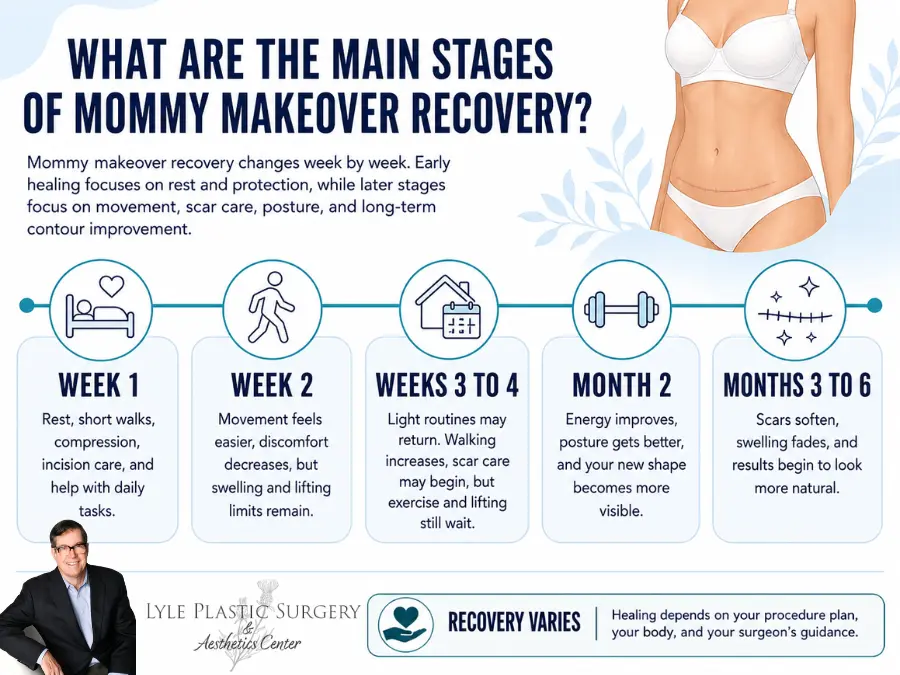
What Are the Main Stages of Mommy Makeover Recovery?

Mommy makeover healing changes week by week as swelling improves, discomfort decreases, and your body gradually adjusts to its new shape. Each phase has a different focus, from rest and incision protection to scar care, posture, activity, and long-term contour refinement.

  • Week 1 is focused on rest, short walks, compression, incision care, and help with daily tasks.
  • Week 2 often brings easier movement, less discomfort, and a little more independence.
  • Weeks 3 to 4 may allow a return to light routines, although exercise and lifting are still limited.
  • Month 2 often brings more energy, better posture, and more visible shape improvement.
  • Months 3 to 6 are when scars soften, swelling decreases, and results begin looking more natural.

A week-by-week guide is helpful, but your actual recovery depends on the exact combination of procedures in your mommy makeover.

What Is Early Mommy Makeover Recovery Like?

Early mommy makeover recovery usually feels tight, swollen, sore, and physically limited. This is the stage when your body needs the most rest, support, and protection from lifting, bending, reaching, or doing too much too soon.

  • You’ll need a trusted adult to drive you home and help you during the first several days.
  • Short walks around the house are encouraged to support circulation and reduce stiffness.
  • You may need to sleep in a reclined position, especially if a tummy tuck was performed.
  • Compression garments, surgical bras, or binders should be worn exactly as directed.
  • Drains may be used after a tummy tuck, and you’ll receive instructions for caring for them.

The first week is not about getting back to normal; it’s about giving your body a calm, safe start.

What Can You Usually Do by Week Two?

The second week of mommy makeover recovery often brings less pain, easier movement, and more confidence with simple daily activities. You may feel more mobile and more hopeful, but your incisions and internal repairs still need careful protection.

  • Walking may feel smoother, although you may still move slowly or slightly bent after a tummy tuck.
  • Bruising may begin to fade, but swelling can still feel very noticeable.
  • You may need less prescription pain medication as soreness improves.
  • Drains may be removed if output is low enough and Dr. Lyle’s team feels it’s safe.
  • Lifting children, laundry baskets, groceries, and pets should still wait.

Week two can feel encouraging, but it’s still a protected recovery phase.

When Can You Return to Light Family Routines?

Many mommy makeover patients can ease back into light family routines around weeks three and four, but they still need help with lifting, childcare, and physically demanding tasks. You may feel more independent by this stage, yet your body is still healing underneath the surface.

  • Desk work, light errands, and simple household routines may feel more manageable.
  • Walking can usually increase gradually as long as it stays comfortable.
  • Swelling may improve in the morning and become more noticeable later in the day.
  • Scar care may begin or change if Dr. Lyle clears you.
  • Core workouts, chest workouts, running, heavy lifting, and intense yoga should still wait.

This stage often feels like progress, but it should not feel like a full return to your pre-surgery routine.

What Changes Two Months After a Mommy Makeover?

Around the second month, many mommy makeover patients notice better energy, less swelling, improved posture, and a clearer sense of their new shape. Breast shape, abdominal contour, waist definition, and scar appearance may all continue changing during this phase.

  • Clothing may begin fitting more comfortably as swelling improves.
  • Breast implants, if used, may start softening and settling into a more natural position.
  • Tummy tuck tightness may improve, although the abdomen may still feel firm or numb.
  • Low-impact activity may be allowed if Dr. Lyle confirms healing is on track.
  • Compression garments or support bras may still be part of the recovery plan.

Month two is often when patients start feeling more like themselves, but the final result is still developing.

What Happens Between Three and Six Months After Surgery?

Between three and six months after a mommy makeover, scars and swelling continue improving while the body settles into a more natural shape. Many patients feel more comfortable, move more normally, and begin seeing a more refined version of their result.

  • Swelling usually decreases gradually but can still fluctuate after travel, heat, activity, or salty meals.
  • Breast and tummy tuck scars may look pink, red, raised, or firm before they soften.
  • Silicone strips, silicone-based scar cream, taping, or other scar treatments may be recommended.
  • Scar massage may be introduced later when the incisions are ready.
  • Final contour refinement often continues for 6 to 12 months.

Even when you feel mostly recovered, your mommy makeover results can keep improving quietly in the background.

Main Stages of Mommy Makeover Recovery - Infographics Image by Dr Lyle

Meet Dr. Glenn Lyle

Board Certified Plastic Surgeon

Dr. Glenn Lyle, a board-certified plastic surgeon, has been proudly serving the Raleigh, NC, community at Lyle Plastic Surgery and Aesthetics Center since 2002. With a deep passion for helping patients reclaim their confidence, Dr. Lyle specializes in transformative breast surgery and body contouring procedures. Whether addressing the effects of weight loss, pregnancy, or aging, his expert care and artistic approach empower individuals to look and feel their best. Dr. Lyle is dedicated to creating beautiful, natural results that reflect each patient’s personal journey and goals.

When Can You Bathe Normally After a Mommy Makeover?

You can usually shower after a mommy makeover once Dr. Lyle confirms that your incision care plan allows it. Timing can vary because a mommy makeover may include breast surgery, tummy tuck surgery, liposuction, or multiple incision areas.

  • You may need to keep dressings, tape, or incision areas dry during the earliest stage.
  • Long, hot showers should wait because heat and steam can increase swelling or lightheadedness.
  • Let water run gently over the body instead of scrubbing near the incisions.
  • Pat the skin dry carefully and avoid applying lotions, oils, or creams unless approved.
  • Baths, pools, hot tubs, and swimming should wait until all incisions are fully healed.

Showering should be gentle, simple, and based on your exact procedure combination.

When Can You Resume Driving, Work, and Workouts?

Most mommy makeover patients return to driving, work, and exercise in stages rather than all at once. Your timeline depends on the procedures included, whether muscle repair was performed, your medication use, and how physically demanding your routine is.

  • Driving may resume once you’re off narcotic pain medication and can turn, brake, and react safely.
  • Desk work may be possible around two to three weeks, depending on energy, soreness, and commute demands.
  • Physical jobs usually require more time because lifting, bending, and repeated movement can strain healing tissues.
  • Light walking starts early, but workouts should wait until Dr. Lyle clears you.
  • Core workouts, chest exercises, running, and high-impact activity usually need more time after combined surgery.

A careful return to activity protects your incisions, breast results, abdominal repair, and overall comfort.

Which Garments Help Support Mommy Makeover Recovery?

The garments that support mommy makeover recovery depend on which procedures are included in your surgical plan. Many patients wear a surgical bra, abdominal binder, compression garment, or a combination of support pieces during different stages of healing.

  • A surgical bra may support the breasts after augmentation, lift, or reduction.
  • An abdominal binder may be used early after a tummy tuck to support the midsection.
  • Compression garments may help manage swelling after liposuction or body contouring.
  • Garments should feel supportive, not painfully tight or restrictive.
  • Dr. Lyle’s team will explain when to wear each garment and when to transition.

The right garment plan should help you feel supported without placing too much pressure on healing tissues.

How Should You Sleep After a Mommy Makeover?

The best way to sleep after a mommy makeover is usually on your back with your upper body elevated and your knees slightly bent. This position is especially helpful when breast surgery and tummy tuck surgery are performed together.

  • A recliner or wedge pillow can help you stay elevated during the first stage of recovery.
  • Pillows under your knees can reduce tension across the lower abdomen.
  • Sleeping on your stomach should wait until Dr. Lyle clears you.
  • Side sleeping may be uncomfortable early, especially after breast surgery or if drains are present.
  • Keeping essentials nearby can reduce reaching, twisting, and unnecessary movement.

A comfortable sleep setup can make the first few weeks easier and help you avoid strain while moving in and out of bed.

What Will Mommy Makeover Scars Look Like as They Heal?

Mommy makeover scars usually change from pink or red early on to softer, flatter, lighter lines over time. Their appearance depends on incision locations, skin type, scar care, sun protection, procedure combination, and your body’s natural healing pattern.

  • Breast scars may be around the areola, vertical, under the breast crease, or placed according to the procedure performed.
  • Tummy tuck scars are usually placed low on the abdomen when anatomy allows.
  • Liposuction scars are typically small but still need proper care.
  • Silicone strips, silicone-based scar cream, or taping may be recommended once incisions are ready.
  • Scars can continue improving for a year or longer.

Mommy makeover scars take time to mature, but consistent scar care can help them fade more smoothly.

Which Symptoms Are Normal During Mommy Makeover Recovery?

Swelling, tightness, bruising, numbness, soreness, and fatigue are normal during mommy makeover recovery. Because multiple areas may be healing at once, symptoms can feel different from one part of the body to another.

  • The abdomen may feel tight, firm, numb, or swollen after tummy tuck surgery.
  • The breasts may feel high, firm, sensitive, or swollen after breast surgery.
  • Liposuction areas may feel tender, lumpy, bruised, or uneven early on.
  • Swelling may change throughout the day and often increases after activity.
  • Energy may come and go, especially during the first several weeks.

Normal healing can feel uneven, but steady improvement over time is usually the most reassuring sign.

When Should You Contact Dr. Lyle During Recovery?

You should contact Dr. Lyle’s office if you notice sudden, severe, or unusual symptoms after a mommy makeover. Most recovery changes are expected, but certain symptoms should be checked promptly.

  • Fever, chills, or feeling suddenly unwell
  • Sudden one-sided swelling, increasing pain, or significant asymmetry
  • Increasing redness, warmth, drainage, or incision opening
  • Shortness of breath, chest pain, or calf pain
  • A drain that stops working, loses suction, or has a major output change

It’s always better to call with a concern than to wait and worry at home.

What Is Dr. Lyle’s Approach to Mommy Makeover Scar Care?

Dr. Lyle’s approach to mommy makeover scar care includes careful incision planning, precise closure, and consistent post-op guidance. Since a mommy makeover may involve several incision areas, scar care is customized to each procedure and healing stage.

  • Incisions are planned to create the best possible contour while keeping scars as discreet as anatomy allows.
  • Early incision support may include tape, dressings, or specific wound-care instructions.
  • Silicone strips or silicone-based scar cream may be recommended once the skin is ready.
  • Scar massage may be introduced later when the incisions are strong enough.
  • Light-based or laser treatments may be considered for redness, thickness, or texture when appropriate.

Good scar care takes consistency, and Dr. Lyle’s team will guide you through the right timing.

Explore Our

Before & Afters

What Should You Refrain From During Mommy Makeover Recovery?

During mommy makeover recovery, you should avoid lifting, overexertion, poor garment use, and judging your results too early. Because multiple procedures may be healing at once, it’s especially important to follow instructions carefully.

  • Lifting children, pets, groceries, laundry baskets, or heavy objects before clearance
  • Returning to core workouts, chest exercises, running, or intense fitness too soon
  • Wearing compression too tightly or switching garments without guidance
  • Sleeping on your stomach before your body is ready
  • Comparing your swelling, scars, or shape to someone else’s recovery online

Avoiding these mistakes helps protect your comfort, incisions, and final mommy makeover result.

What Makes Dr. Glenn Lyle a Top Choice for Mommy Makeover Surgery?

Dr. Lyle personalizes mommy makeover recovery around the exact procedures, anatomy, lifestyle, and goals of each patient. His focus is safe surgical planning, natural-looking results, practical recovery instructions, and attentive follow-up care.

  • Dr. Lyle is a board-certified plastic surgeon in Raleigh, NC, with extensive experience in breast and body contouring surgery.
  • Recovery instructions may vary depending on whether your makeover includes a tummy tuck, breast augmentation, breast lift, breast reduction, liposuction, or fat transfer.
  • His team guides patients through support garments, scar care, drains when used, activity restrictions, and follow-up visits.
  • His approach emphasizes proportionate, natural-looking improvements rather than an overdone result.
  • Each recovery plan is designed around the patient’s real life, including work, childcare, exercise, and home support.

Personalized recovery matters because no two mommy makeover patients have the same combination of procedures or responsibilities.

What Helps You Stay Positive After a Mommy Makeover?

You may feel emotional after a mommy makeover because your body, energy, independence, and self-image are all changing at the same time. Early results can be exciting, but swelling, scars, and waiting for the final outcome can also feel frustrating.

  • You may feel encouraged one day and impatient the next.
  • Swelling can hide the final contour for weeks or months.
  • Breast implants, if used, may need time to soften and settle.
  • Scar color and thickness can change before they fade.
  • Follow-up visits can help you understand what’s normal and what still needs time.

A mommy makeover is a long-term transformation, and patience is part of seeing the result fully develop.

What Should Natural Mommy Makeover Results Look Like?

Natural mommy makeover results should look balanced, proportionate, and comfortable for your body. Dr. Lyle’s approach focuses on breast shape, abdominal contour, waist balance, scar placement, and overall harmony rather than an overdone look.

  • Breast size and shape should match the patient’s frame and goals.
  • The abdomen should look flatter and smoother without appearing overly tight.
  • Liposuction should refine the contour without creating an exaggerated look.
  • Scars should be placed as discreetly as possible based on anatomy.
  • The final result should look balanced in clothing, swimwear, and everyday life.

The best mommy makeover result looks refreshed, proportionate, and true to the patient’s body.

Why Do Many Women Choose Combined Breast and Body Surgery?

Many patients feel a mommy makeover is worth the recovery because it can improve several pregnancy-related body changes in one surgical plan. The recovery takes patience, but the results can feel meaningful for women who want to restore comfort, shape, and confidence.

  • A tummy tuck can improve loose abdominal skin and muscle separation.
  • Breast surgery can restore volume, lift, reduce heaviness, or improve shape.
  • Liposuction can refine stubborn areas that don’t respond to exercise.
  • Combining procedures may reduce the need for multiple separate recoveries.
  • Patients often feel more comfortable in clothing, swimwear, and activewear.

A mommy makeover is a personal decision, but for the right candidate, the recovery can be well worth the transformation.

Ready to Plan Your Mommy Makeover With Dr. Lyle in Raleigh, NC?

You can start planning a mommy makeover in Raleigh, NC, by scheduling a personalized consultation with Dr. Glenn Lyle. He’ll evaluate your anatomy, listen to your goals, review procedure options, and explain what recovery may look like for your specific plan.

  • Your consultation can help determine whether you need breast surgery, tummy tuck surgery, liposuction, fat transfer, or a combined approach.
  • Dr. Lyle can explain how each procedure may affect your recovery timeline.
  • You’ll learn how much downtime to plan based on your work, childcare, and home responsibilities.
  • The team can review garments, drains, scar care, activity limits, and follow-up visits.
  • You’ll have time to ask questions before deciding whether a mommy makeover is right for you.

If you’re considering a mommy makeover in Raleigh, NC, schedule a consultation with Dr. Glenn Lyle to learn what’s possible and how to plan for a safe, supported recovery.

FAQs About Mommy Makeover Recovery

Why do I feel more swollen at night after a mommy makeover?

Swelling often looks worse at night because you’ve been upright, walking, sitting, and moving throughout the day. This is common after combined surgery and usually improves gradually as inflammation decreases. Also, your intestines may trap gas and the diastasis repair might make you feel bloated.

Your abdomen and breasts can feel different because each area is healing from a different type of surgery. A tummy tuck often creates tightness from skin removal and muscle repair, while breast surgery may cause soreness, pressure, or sensitivity.

Yes, you can recover without a recliner if you can create a comfortable elevated position in bed. A wedge pillow behind your back and pillows under your knees can help reduce tension after tummy tuck and breast surgery.

Early unevenness can happen because swelling, bruising, implant settling, and tissue healing rarely happen at the exact same speed on both sides. Mild asymmetry can be normal, but sudden swelling, sharp pain, or major shape changes should be checked by Dr. Lyle’s office.

You can use your arms gently after breast surgery, but repeated reaching, pushing, pulling, or lifting should be limited early on. Too much upper-body activity can strain healing breast tissue and incisions.

A tummy tuck scar can feel tight when you stand because the lower abdominal skin and deeper tissues are healing under tension. The operating table is flexed during abdominoplasty to facilitate pannus removal and closure. The skin relaxes over time but feels tight initially.  This usually improves as swelling decreases, posture relaxes, and the incision matures.

It can be normal to feel emotional, overwhelmed, or temporarily regretful during the first week because discomfort, swelling, limited movement, and dependence on others can feel intense. These feelings often improve as pain decreases, mobility returns, and early results become easier to see. By  4 weeks, you are turning the corner and can look forward to how your clothes will fit once the compression garments aren’t needed.

Mommy Makeover Overview – American Society of Plastic Surgeonshttps://www.plasticsurgery.org/cosmetic-procedures/mommy-makeover

Mommy Makeover Aftercare and Recovery – The Aesthetic Societyhttps://prod.theaestheticsociety.org/procedures/body/mommy-makeover/aftercare-recovery

Combined Surgery (Mommy-Makeover) Compared to Single Procedure (Abdominoplasty) in After-Pregnancy Women: A Prospective Study on Risks and Benefits – Aesthetic Plastic Surgeryhttps://link.springer.com/article/10.1007/s00266-023-03579-6

A Comparative Analysis of the Complication Rate in “Mommy Makeover” Procedures and Abdominoplasty – Israel Medical Association Journalhttps://www.ima.org.il/MedicineIMAJ/viewarticle.aspx?year=2025&month=08&page=526

Further Reading

Real Reviews from Real Patients

Let’s Start a Conversation