Tummy Tuck Recovery in Raleigh, NC: Abdominoplasty Timeline and Healing Tips
A tummy tuck recovery takes patience, planning, and the right guidance, but most patients feel more confident when they understand what’s coming. With Dr. Glenn Lyle’s personalized approach in Raleigh, NC, patients can move through each stage of healing with clear expectations and support.
Recovery isn’t just about resting. It’s about protecting the abdominal repair, managing swelling, walking safely, and giving your body enough time to heal properly.
Most patients need help at home during the first several days, especially with children, pets, meals, and transportation. Swelling, tightness, and fatigue are normal early on, but they gradually improve as healing progresses.
Quick Links
- What Is a Tummy Tuck?
- How Long Does Tummy Tuck Recovery Take?
- Week-by-Week Tummy Tuck Recovery Timeline
- Week 1: Rest, Walking, and Protecting Your Incision
- Week 2: Standing Taller and Moving More Comfortably
- Weeks 3 to 4: Returning to Light Routines
- Month 2: More Energy, Less Swelling, and Gradual Exercise
- Months 3 to 6: Scar Maturation and Final Contour Refinement
- Will I Have Drains After a Tummy Tuck?
- What Compression Garments Will I Wear After a Tummy Tuck?
- How Should I Sleep After a Tummy Tuck?
- When Can I Stand Up Straight After a Tummy Tuck?
- When Can I Drive, Work, and Exercise After a Tummy Tuck?
- How Does Muscle Repair Affect Tummy Tuck Recovery?
- What Is Normal After a Tummy Tuck?
- What Warning Signs Should I Call Dr. Lyle About?
- How Does Dr. Lyle Help Minimize Tummy Tuck Scars?
- What Are the Most Common Tummy Tuck Recovery Mistakes?
- Why Dr. Glenn Lyle’s Tummy Tuck Recovery Process Is Different
- The Emotional Side of Tummy Tuck Recovery
- Tummy Tuck Before and After Photos
- Is a Tummy Tuck Recovery Worth It?
- Schedule a Tummy Tuck Consultation in Raleigh, NC
- FAQs About Tummy Tuck Recovery
- Medical References
- Further Reading
What Is a Tummy Tuck?
A tummy tuck, or abdominoplasty, removes loose abdominal skin and tightens the midsection to create a flatter, more supported contour. It’s often chosen by women who have stretched skin, muscle separation, or lower belly fullness after pregnancy, weight changes, aging, or prior abdominal surgery.
The procedure can remove excess skin that hangs, folds, or doesn’t tighten with exercise. It can also repair diastasis recti, which is the separation of the abdominal muscles that can make the abdomen look rounded or unsupported.
Dr. Lyle customizes each tummy tuck based on skin quality, muscle separation, scar position, body type, and personal goals. A tummy tuck isn’t a shortcut or a weight-loss procedure; it’s a carefully planned body contouring surgery designed to improve abdominal shape, support, and confidence.
How Long Does Tummy Tuck Recovery Take?
Most tummy tuck patients need about two to three weeks of meaningful downtime before returning to light routines. Full recovery takes longer because swelling, scar healing, and internal tissue repair continue for several months.
- Gentle walking usually begins the same day or the day after surgery.
- Driving may be possible around two weeks, once you’re off narcotic pain medication and can move safely.
- Desk work is often possible around two to three weeks, depending on your comfort and energy.
- Light exercise may resume around four to six weeks if Dr. Lyle clears you.
- Final contour improvements often continue for 6 to 12 months as swelling settles.
The key is to think of recovery in stages rather than expecting one fixed “back to normal” date.
Week-by-Week Tummy Tuck Recovery Timeline
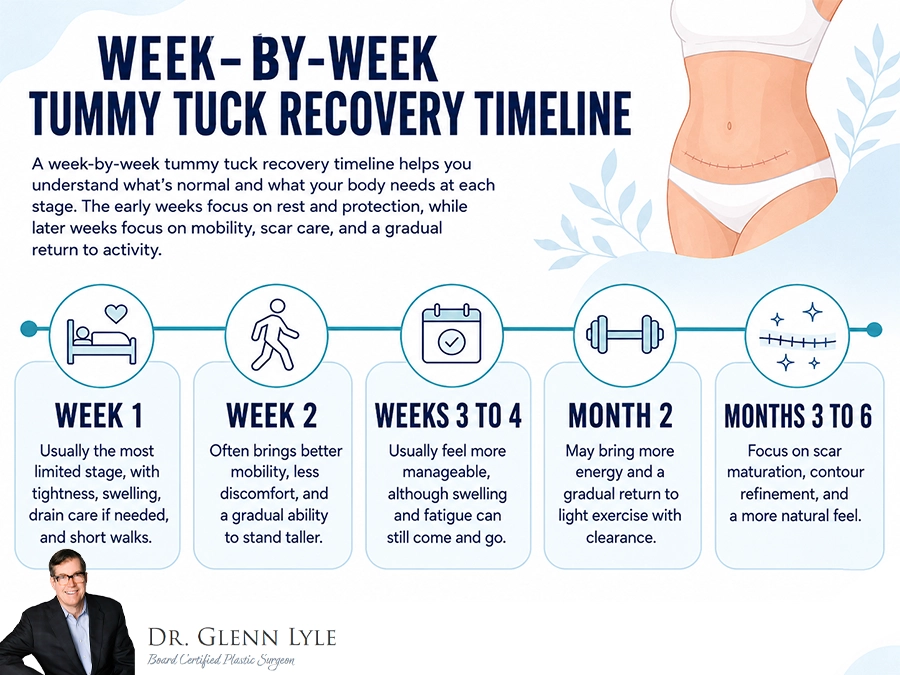
A week-by-week tummy tuck recovery timeline helps you understand what’s normal and what your body needs at each stage. The early weeks focus on rest and protection, while later weeks focus on mobility, scar care, and a gradual return to activity.
- Week 1 is usually the most limited stage, with tightness, swelling, drain care if needed, and short walks.
- Week 2 often brings better mobility, less discomfort, and a gradual ability to stand taller.
- Weeks 3 to 4 usually feel more manageable, although swelling and fatigue can still come and go.
- Month 2 may bring more energy and a gradual return to light exercise with clearance.
- Months 3 to 6 focus on scar maturation, contour refinement, and a more natural feel.
A tummy tuck recovery timeline is helpful, but your own progress matters more than the calendar.
Week 1: Rest, Walking, and Protecting Your Incision
The first week after a tummy tuck is about resting, walking gently, and avoiding tension on your incision. You’ll likely feel tight, swollen, and sore, but those early symptoms are expected as your body begins healing.
- Walk slowly around the house several times a day to support circulation.
- Rest in a reclined position with your upper body elevated and knees slightly bent.
- Wear your binder or compression garment as instructed, without making it tighter than recommended.
- Follow drain-care instructions carefully if drains are used.
- Avoid lifting, bending, twisting, pushing, pulling, or reaching in ways that strain your abdomen.
The first week is not the time to test your limits; it’s the time to let your body settle and heal.
Week 2: Standing Taller and Moving More Comfortably
By the second week, many patients can stand a little taller and move around with more confidence. You’ll still need to be careful, though, because feeling better doesn’t mean the abdominal repair is fully healed.
- Walking may feel smoother, and you should need little or no prescription pain medication or maybe just Tylenol or Motrin. Narcotic pain pills may occasionally be used at night.
- Bruising may fade, although swelling can still be noticeable.
- Drains usually are removed if your fluid output is low enough.
- Driving may be possible if you’re off narcotic medication and can react safely.
- Heavy lifting, childcare lifting, heavy grocery bags, laundry baskets, and workouts should still wait.
Week two often feels encouraging, but it’s still a protected phase of recovery.
Weeks 3 to 4: Returning to Light Routines
Weeks three and four are when many patients start easing back into light routines. You may feel more independent, but swelling, tightness, and limited core strength are still completely normal.
- Desk work, short outings, and light household tasks may feel more manageable.
- Walking can usually increase gradually, as long as it is not “power walking” or too vigorous.
- Swelling may look better in the morning and worse later in the day.
- Scar care may begin or change during this stage if Dr. Lyle clears you. Silicone scar tapes are usually started.
- Core exercises, heavy lifting, high-impact workouts, Pilates, and intense yoga should still wait. Light arm weights can be used.
This stage often brings visible progress, but your final tummy tuck result is still developing.
Month 2: More Energy, Less Swelling, and Gradual Exercise
By the second month, many tummy tuck patients have more energy, better posture, and a clearer sense of their new abdominal shape. Some patients may begin light exercise during this phase, but only with Dr. Lyle’s approval.
- Walking usually feels easier and more natural.
- Low-impact activity may be introduced if healing is on track.
- Swelling often improves, but it can still fluctuate after activity, travel, heat, or salty meals. Compression garments or “fahas” are still recommended.
- The lower abdomen may still feel numb, tight, or firm.
- Core workouts usually need more time, especially after muscle repair. Core engagement can start but no trunk flexion exercises.
Month two is a turning point for many patients, but a slow return to activity is still the safest approach.
Months 3 to 6: Scar Maturation and Final Contour Refinement
Between three and six months, most tummy tuck patients feel much more comfortable and confident in their results. The abdomen usually looks flatter and softer, while scars gradually begin to fade and settle.
- Swelling continues to decrease, especially in the lower abdomen.
- The abdominal contour becomes more refined as tissues soften.
- Scars may still look pink, red, raised, or firm, which can be normal.
- Silicone strips, silicone scar cream, taping, or other scar treatments are still recommended through 3 months.
- Exercise may become less restricted depending on Dr. Lyle’s guidance.
Even when you feel mostly recovered, subtle improvements can continue for 6 to 12 months.
Meet Dr. Glenn Lyle
Board Certified Plastic Surgeon
Dr. Glenn Lyle, a board-certified plastic surgeon, has been proudly serving the Raleigh, NC, community at Lyle Plastic Surgery and Aesthetics Center since 2002. With a deep passion for helping patients reclaim their confidence, Dr. Lyle specializes in transformative breast surgery and body contouring procedures. Whether addressing the effects of weight loss, pregnancy, or aging, his expert care and artistic approach empower individuals to look and feel their best. Dr. Lyle is dedicated to creating beautiful, natural results that reflect each patient’s personal journey and goals.
Will I Have Drains After a Tummy Tuck?
Many tummy tuck patients do have drains because drains help remove extra fluid while the abdominal tissues begin healing together. They may feel inconvenient at first, but they can play an important role in reducing fluid buildup during early recovery.
- A drain is a small tube connected to a soft collection bulb.
- Dr. Lyle commonly uses drains for tummy tuck patients, especially when muscle repair or larger skin removal is involved.
- Drain removal depends on fluid output, not just the number of days since surgery.
- You’ll be shown how to empty the bulbs and record the amount of fluid.
- You should call the office if the drain stops working, the bulb won’t hold suction, or the output changes suddenly.
Drains are temporary, and Dr. Lyle’s team will guide you through each step until they’re ready to come out.
What Compression Garments Will I Wear After a Tummy Tuck?
You’ll usually wear compression after a tummy tuck to support the abdomen and help control swelling. Dr. Lyle often starts with an abdominal binder and may transition patients into a compression garment as healing progresses.
- Compression helps the abdomen feel supported when standing, walking, or changing positions.
- A binder may be used early because it’s adjustable and easy to manage after surgery.
- A compression garment is used later as swelling changes and mobility improves.
- The garment should feel supportive, not painfully tight.
- Too much pressure too soon can be uncomfortable and may not help healing.
The right compression plan should make you feel supported, not squeezed.
How Should I Sleep After a Tummy Tuck?
The best way to sleep after a tummy tuck is on your back with your upper body elevated and your knees slightly bent. This position helps reduce pulling across the incision and makes it easier to rest comfortably in the early days.
- A recliner can be helpful during the first week or two.
- A wedge pillow behind your back can create a similar elevated position in bed.
- Pillows under your knees help soften tension across the lower abdomen.
- Stomach or side sleeping should wait until Dr. Lyle clears you.
- Keep water, medication, your phone, and other essentials within reach.
- If you have a bedroom upstairs, it will be difficult to navigate them in the first few weeks so consider sleeping in a bed or recliner on the first floor .
A good sleep setup can make early recovery much easier and help you avoid unnecessary strain.
When Can I Stand Up Straight After a Tummy Tuck?
Most patients begin standing more upright during the first two weeks after a tummy tuck. It’s normal to walk slightly bent at first because this protects the incision and reduces tension across the lower abdomen.
- You shouldn’t force yourself to stand fully straight before your body is ready.
- Tightness across the abdomen is common, especially if muscle repair was performed.
- Posture usually improves gradually as swelling decreases and the incision feels less tense.
- Walking a little each day can help your body ease back into a more natural position.
- Dr. Lyle will let you know when your posture and movement are progressing appropriately.
Standing upright after a tummy tuck is a gradual process, not something you need to rush. Most patients are able to stand upright after their one week appointment but will favor a slightly hunched posture through week two.
When Can I Drive, Work, and Exercise After a Tummy Tuck?
Most patients can return to driving, desk work, and exercise in stages after a tummy tuck. The safest timeline depends on your comfort, medication use, healing progress, and whether your procedure included muscle repair or liposuction.
- Driving may be possible around two weeks if you’re off narcotic pain medication and can brake, turn, and react safely.
- Desk work is often possible around two to three weeks, especially if you can take breaks and avoid long periods of sitting still.
- Physical jobs usually require more time because lifting, bending, and repeated movement can strain the abdomen.
- Light exercise may begin around four to six weeks if Dr. Lyle clears you.
- Core workouts usually take longer and should not resume until your abdominal repair is strong enough.
Your return to normal activity should feel steady and controlled, not rushed or forced.
How Does Muscle Repair Affect Tummy Tuck Recovery?
Muscle repair can make tummy tuck recovery feel tighter and more restrictive because the deeper abdominal wall is healing, not just the skin. If Dr. Lyle repairs diastasis recti, your core needs extra time before it can safely handle lifting, twisting, or abdominal exercise.
- Muscle repair can create a firm, tight feeling through the midsection during early recovery.
- Sitting up, coughing, laughing, or getting out of bed may feel more difficult at first.
- Core exercises such as sit-ups, crunches, planks, Pilates, and intense yoga need to wait.
- Lifting children, pets, or heavy objects too soon can place stress on the repair.
- A slower return to activity helps protect the internal support created during surgery.
Muscle repair is one reason tummy tuck recovery should be treated with more caution than simple skin or fat removal.
What Is Normal After a Tummy Tuck?
Swelling, tightness, bruising, numbness, and fatigue are all normal after a tummy tuck. These symptoms usually improve gradually, but healing is rarely perfectly smooth from one day to the next.
- Swelling may look worse later in the day or after activity.
- The lower abdomen may feel numb, firm, itchy, or uneven for a while.
- Bruising often fades before swelling fully resolves.
- One side may feel slightly different from the other during early healing.
- Energy can fluctuate, especially during the first few weeks.
Normal recovery can feel different from what you expected, but gradual improvement is usually the most important sign.
What Warning Signs Should I Call Dr. Lyle About?
You should call Dr. Lyle’s office if you notice symptoms that feel sudden, severe, or very different from your normal recovery pattern. Most recovery changes are expected, but certain signs deserve prompt attention.
Although uncommon, complications can occur after tummy tuck. They are usually minor although they might seem alarming.
- Fever, chills, or feeling suddenly unwell
- Sudden increase in pain, swelling, redness, or drainage
- Shortness of breath, chest pain, or calf pain
- A drain that stops working, loses suction, or has a major output change
- Incision opening, spreading redness, or unusual fluid from the incision
It’s always better to contact the office with a concern than to wait and worry at home.
How Does Dr. Lyle Help Minimize Tummy Tuck Scars?
Dr. Lyle helps minimize tummy tuck scars through careful incision planning, thoughtful closure, and guided scar care after surgery. While every tummy tuck creates a scar, the goal is to help it heal as flat, smooth, and discreetly placed as possible.
- The incision is typically placed low enough to be hidden by many underwear and swimsuit styles when anatomy allows.
- Early incision support may include surgical dressings, tape, or other instructions based on your healing.
- Silicone strips or silicone-based scar cream may be recommended once the incision is ready.
- Scar massage may be introduced later, but only when Dr. Lyle clears you.
- Light-based treatments or laser options may be considered for redness, texture, or scar quality when appropriate.
A tummy tuck scar takes time to mature, but consistent care can make a meaningful difference in how it softens and fades.
What Are the Most Common Tummy Tuck Recovery Mistakes?
The most common tummy tuck recovery mistakes happen when patients feel better and start doing too much too soon. Recovery is easier when you respect the limits of your incision, muscle repair, swelling, and energy level.
- Standing fully upright too early can create pulling across the incision
- Lifting children, pets, groceries, laundry baskets, or heavy objects before clearance
- Returning to core workouts, Pilates, intense yoga, or heavy exercise too soon
- Wearing compression too tightly instead of following the garment instructions
- Comparing your swelling or scar progress to someone else’s recovery online
Avoiding these mistakes helps reduce setbacks and gives your body the best chance to heal smoothly.
Why Dr. Glenn Lyle’s Tummy Tuck Recovery Process Is Different
Dr. Glenn Lyle’s tummy tuck recovery process is different because it’s personalized to each patient’s anatomy, procedure, and healing progress. His approach focuses on safe abdominal contouring, careful follow-up, practical recovery instructions, and natural-looking results. Many franchised surgery centers or high volume practices have cookie cutter approaches, hire less qualified surgeons, some not even Board Certified. Dr. Lyle has 32 years experience and takes responsibility for your care.
- Dr. Lyle is a board-certified plastic surgeon in Raleigh, NC, with extensive experience in body contouring. With 32 years in practice, he has seen just about everything and will be happy to check on you in the office with concerns.
- He plans each tummy tuck around skin laxity, muscle separation, scars, body shape, and patient goals.
- His technique is designed to create a flatter abdomen without making the tissues excessively tight.
- He commonly uses drains and compression thoughtfully when they support safer healing.
- His team guides patients through scar care, garment use, activity restrictions, and follow-up visits.
- Although out of state visitors are welcome, the majority of his patients are from North Carolina, Virginia and South Carolina. He prefers being able to followup with his patients regularly.
The difference is not just the surgery itself; it’s the care, planning, and guidance that support your recovery from start to finish.
The Emotional Side of Tummy Tuck Recovery
The emotional side of tummy tuck recovery is real, and many patients feel a mix of excitement, impatience, and vulnerability while they heal. Swelling, limited activity, and waiting for final results can be frustrating, even when recovery is going well.
- It’s normal to feel emotional during the first few weeks after surgery.
- Early swelling can make it hard to appreciate your final shape right away.
- Fatigue and temporary dependence on others can affect your mood.
- Progress photos can help you see improvement that may be hard to notice daily.
- Follow-up visits can provide reassurance when you’re unsure what’s normal.
Healing takes both physical and emotional patience, and you don’t have to navigate that process alone.
Tummy Tuck Before and After Photos
Tummy tuck before and after photos can help you understand what’s possible and what realistic results may look like. They’re especially helpful when viewing patients with similar concerns, such as loose skin, C-section changes, abdominal muscle separation, or post-weight-loss laxity.
- Look for results that appear natural, balanced, and proportionate.
- Pay attention to scar placement, belly button appearance, waist contour, and lower abdominal smoothness.
- Remember that photos show results at one point in time, not the full recovery journey.
- During consultation, Dr. Lyle can explain what may be realistic for your body.
- Gallery photos can help you communicate your goals more clearly.
Before and after photos are useful, but your best result starts with a personalized consultation and a plan built around your anatomy.
Is a Tummy Tuck Recovery Worth It?
For many patients, tummy tuck recovery is worth it because the procedure can improve abdominal shape, skin laxity, and confidence in a way lifestyle changes alone cannot. The recovery takes time, but the results can feel meaningful for patients who have struggled with loose skin or abdominal changes after pregnancy, aging, or weight loss.
- Patients often feel more comfortable in fitted clothing, swimwear, and activewear.
- Repairing muscle separation may improve the feeling of abdominal support.
- Removing loose skin can reduce folding, rubbing, or frustration with the lower abdomen.
- Combining tummy tuck with liposuction may improve the waist and overall contour.
- A stable weight and healthy habits help maintain results long term.
A tummy tuck is a personal decision, but the right patient can find the recovery process well worth the improvement in comfort, shape, and confidence.
Schedule a Tummy Tuck Consultation in Raleigh, NC
The best way to understand your tummy tuck recovery is to meet with Dr. Glenn Lyle for a personalized consultation. He’ll evaluate your abdomen, discuss your goals, explain your options, and help you understand what recovery may look like for your specific procedure.
- Your consultation can determine whether you need skin removal, muscle repair, liposuction, or a combination approach.
- Dr. Lyle can review your prior scars, weight history, pregnancies, and lifestyle needs.
- You’ll learn how much downtime to plan for based on your procedure and daily responsibilities.
- The team can explain garment use, drain expectations, scar care, and follow-up visits.
- You’ll have time to ask questions and feel comfortable before making a decision.
If you’re considering a tummy tuck in Raleigh, NC, schedule a consultation with Dr. Glenn Lyle to learn what’s possible and how to plan for a safe, supported recovery.
FAQs About Tummy Tuck Recovery
Why does my stomach feel hard after a tummy tuck?
Your stomach can feel hard after a tummy tuck because swelling, tissue healing, and internal tightness can make the abdomen feel firm for weeks or months. This usually softens gradually as swelling improves and the tissues settle.
Why do I swell more at night after a tummy tuck?
Swelling often gets worse at night because you’ve been upright, walking, sitting, and moving throughout the day. This type of swelling fluctuation is common after abdominoplasty and usually improves as your recovery progresses.
Can I laugh, cough, or sneeze after a tummy tuck?
You can laugh, cough, or sneeze after a tummy tuck, but it may feel tight or uncomfortable early on. Holding a pillow gently against your abdomen can provide support and reduce pulling when this happens.
Why do I feel numb below my belly button after a tummy tuck?
Numbness below the belly button is common because small sensory nerves are affected when abdominal skin is lifted and tightened. Sensation often improves slowly, but some areas may take many months to feel more normal. Just like in a C section, some sensation may be permanently affected just above the pubic incision.
Can I sleep on my side after a tummy tuck?
Side sleeping may be uncomfortable at first because it can pull on the incision or place pressure on healing tissues. Most patients start on their back in a reclined position and return to side sleeping only when Dr. Lyle clears them. A soft side pillow is recommended when you start side sleeping. This will cushion your incisions from direct impact with the firm mattress.
Why does my tummy tuck scar look darker before it fades?
A tummy tuck scar may look darker, pinker, or redder during the active healing phase before it begins to fade. Scar color and texture usually improve over time with proper scar care, sun protection, and patience.
Is it normal to feel emotionally frustrated during tummy tuck recovery?
Yes, it’s normal to feel frustrated, emotional, or impatient while recovering from a tummy tuck. Swelling, limited activity, and waiting for final results can be challenging, even when healing is going well.
Medical References
- Tummy Tuck / Abdominoplasty / American Society of Plastic Surgeons – https://www.plasticsurgery.org/cosmetic-procedures/tummy-tuck/recovery
- Patient satisfaction following abdominoplasty: an NHS experience / Journal of Plastic, Reconstructive & Aesthetic Surgery – https://www.jprasurg.com/article/S1748-6815(06)00439-6/abstract
- Does Abdominoplasty Have a Positive Influence on Quality of Life, Self-Esteem, and Emotional Stability? / Plastic and Reconstructive Surgery – https://journals.lww.com/plasreconsurg/abstract/2012/06000/does_abdominoplasty_have_a_positive_influence_on.26.aspx
Further Reading
- Read more about Tummy Tuck for Men
- Read more about Liposuction
- Read more about Mommy Makeover
- Read more about Post Weight Loss Body Contouring
Real Reviews from Real Patients
Lyle Plastic Surgery and Aesthetics Center's new office is absolutely beautiful, so light and bright. The staff is so welcoming and helpful. The results couldn't have been better!
Thank you for making me feel so great and beautiful!!

